1、设计一个数据类型判断类Polymorphism,使用重载、装箱等技术判断一个不带等号的Java表达式的结果的数据类型。 1 2 3 4 5 6 7 8 9 10 11 12 13 14 15 16 17 18 19 20 21 22 23 24 25 26 27 28 29 30 31 32 33 34 35 36 37 38 39 40 41 42 43 44 45 46 47 48 49 50 51 52 53 public class Polymorphism { private final static String INT_TYPE = "int" ; private final static String LONG_TYPE = "long" ; private final static String DOUBLE_TYPE = "double" ; private final static String FLOAT_TYPE = "float" ; private final static String CHAR_TYPE = "char" ; private final static String BYTE_TYPE = "byte" ; private final static String SHORT_TYPE = "short" ; private final static String BOOLAEN_TYPE = "boolean" ; private final static String String_TYPE = "String" ; public static String getType (int i) { return INT_TYPE; } public static String getType (long l) { return LONG_TYPE; } public static String getType (double d) { return DOUBLE_TYPE; } public static String getType (float f) { return FLOAT_TYPE; } public static String getType (char c) { return CHAR_TYPE; } public static String getType (byte by) { return BYTE_TYPE; } public static String getType (short s) { return SHORT_TYPE; } public static String getType (boolean bo) { return BOOLAEN_TYPE; } public static String getType (String Str) { return String_TYPE; } public static String getType (Object obj) { return obj != null ? obj.toString().split("@" )[0 ] : null ; } public static void main (String[] args) { System.out.println("100是" +getType(100 )+"类型" ); System.out.println("1ds是" +getType("1ds" )+"类型" ); System.out.println("8==9是" +getType(8 ==9 )+"类型" ); System.out.println("100.15是" +getType(100.15 )+"类型" ); System.out.println("a是" +getType('a' )+"类型" ); System.out.println("100+222.5是" +getType(100 +222.5 )+"类型" ); System.out.println("100+'a'是" +getType(100 +'a' )+"类型" ); System.out.println("5.9/54是" +getType(5.9 /54 )+"类型" ); System.out.println("599999999L是" +getType(599999999L )+"类型" ); } }
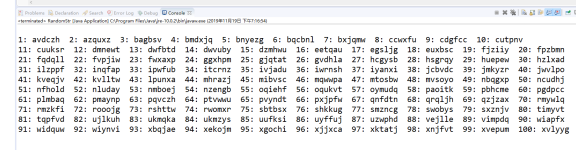
2、设计一个链表结点类LinkNode 此类可以存放int、long、float、double、byte、short、String、StringBuffer类型的数据。用此类:a、随机产生100个整数(范围自定)的链表,在生成的过程中从小到大排列,然后输出;b、随机产生100个6个英文字母的单词的链表,在生成的过程中从小到大排列,然后输出。(关注装箱和拆箱相关概念 Integer String)
1 2 3 4 5 6 7 8 9 10 11 12 13 14 15 16 17 18 19 20 21 22 23 24 25 26 27 28 29 30 31 32 33 34 35 36 37 38 39 40 41 42 43 44 45 46 47 48 49 50 51 52 53 54 55 56 57 58 59 60 61 62 63 64 65 66 67 68 69 70 71 72 73 74 75 76 77 78 79 80 81 82 83 84 85 86 87 88 89 90 91 92 93 94 95 96 97 98 99 100 101 102 103 104 105 106 107 108 109 110 111 112 113 114 115 116 public class LinkNode { public Object value; public LinkNode nextNode; public LinkNode (Object value,LinkNode nextNode) {this .value=value; this .nextNode=nextNode;} public LinkNode () {} public LinkNode (Object value) {this .value=value;} } package text5; public class RandomInt { public static void main (String[] args) { StringBuffer StrB=new StringBuffer (); LinkNode firstNode=new LinkNode (0 ); firstNode.nextNode=new LinkNode (0 ); for (int i=0 ;i<105 ;i++) { LinkNode aNew=new LinkNode (); LinkNode compare=firstNode.nextNode; LinkNode before=firstNode; compare=firstNode.nextNode; int aNum=(int )(Math.random()*1001 ); aNew=new LinkNode (aNum); if (i==0 ) { compare=aNew; continue ; } while (aNum>Integer.parseInt(compare.value.toString())) {if (compare.nextNode!=null ) {compare=compare.nextNode; before=before.nextNode; } else {before=before.nextNode; break ; } } if (before!=compare) {before.nextNode=aNew; aNew.nextNode=compare;} else { compare.nextNode=aNew; } } for (int i=1 ;i<103 ;i++) { if (i>2 ) {System.out.print(i-2 +": " +firstNode.value+" " );} firstNode=firstNode.nextNode; if ((i-2 )%10 ==0 ) System.out.println(); } } }package text5; public class RandomStr { public static void main (String[] args) { StringBuffer StrB=new StringBuffer (); LinkNode firstNode=new LinkNode ("first" ); firstNode.nextNode=new LinkNode (" " ); for (int i=0 ;i<105 ;i++) { LinkNode aNew=new LinkNode (); LinkNode compare=firstNode.nextNode; LinkNode before=firstNode; compare=firstNode.nextNode; StrB=new StringBuffer (); for (int j=0 ;j<6 ;j++) {int aNum=(int )(Math.random()*26 ); char aChar=(char )('a' +aNum); StrB.append(aChar); } aNew=new LinkNode (StrB); if (i==0 ) { compare=aNew; continue ; } while (StrB.toString().compareTo(compare.value.toString())>0 ) {if (compare.nextNode!=null ) {compare=compare.nextNode; before=before.nextNode; } else {before=before.nextNode; break ; } } if (before!=compare) {before.nextNode=aNew; aNew.nextNode=compare;} else { compare.nextNode=aNew; } } for (int i=1 ;i<103 ;i++) { if (i>2 ) {System.out.print(i-2 +": " +firstNode.value+" " );} firstNode=firstNode.nextNode; if ((i-2 )%10 ==0 ) System.out.println(); } } }
3、A、在main()中使用上题的LinkNode类创建4个实例 并赋予不同的值(long、double、 StringBuffer、MyDate),然后使用Object中默认的toString()方法(从超级父类继承而来) 显示结果。
1
2
3
4
5
6
7
8
9
10
11
12
13
14
15
16
17
18
19
20
21
22
23
24
25
26
27
28
29
public class LinkNodes extends LinkNode { public LinkNodes (Object value,LinkNode nextNode) {this .value=value; this .nextNode=nextNode;} public LinkNodes () {} public LinkNodes (Object value) {this .value=value;} public String toString (long longNum) { String str=longNum+"" ; return str; } public String toString (double doubleNum) {String str=doubleNum+"" ; return str; } public String toString (StringBuffer StrBuffer) {String str=StrBuffer+"" ; return str; } public String toString (MyDate myDateNum) {String str=myDateNum.year+" " +myDateNum.month+" " +myDateNum.day+" " +myDateNum.hour+" " +myDateNum.minute+" " +myDateNum.second; return str; } }
B、继承LinkNode类创建新类LinkNodeS 在其中重写Object中默认的toString()方法(将结点的value转换成对应的字符串),main()中用LinkNodeS类同样创建4个实例,并赋予和上面同样的值(long、double、StringBuffer、MyDate),观察使用新的toString()方法的效果,体会继承与多态。(MyDate的日期toString用标准格式)
1
2
3
4
5
6
7
8
9
10
11
12
13
14
15
16
17
18
19
20
21
22
23
24
25
26
27
public class UseOfLinkNodes { public static void main (String[] args) { StringBuffer strBuffer=new StringBuffer ("aaa" ); MyDate myDate=new MyDate (); LinkNode longNum=new LinkNode (594785L ); LinkNode doubleNum=new LinkNode (599.5 ); LinkNode StringBuffer=new LinkNode (strBuffer); LinkNode myDateNum=new LinkNode (myDate); System.out.println(longNum.value.toString()); System.out.println(doubleNum.value.toString()); System.out.println(StringBuffer.value.toString()); System.out.println(myDateNum.value.toString()); System.out.println(); LinkNodes longNum2=new LinkNodes (594785L ); LinkNodes doubleNum2=new LinkNodes (599.5 ); LinkNodes StringBuffer2=new LinkNodes (strBuffer); LinkNodes myDateNum2=new LinkNodes (myDate); String myDateNum2Str=myDateNum2.toString((MyDate)myDateNum2.value); System.out.println(longNum2.toString((long )longNum2.value)); System.out.println(doubleNum2.toString((double )doubleNum2.value)); System.out.println(StringBuffer2.toString((StringBuffer)StringBuffer2.value)); System.out.println(myDateNum2Str); } }
4、:用Animal作为基类,鸟类、昆虫类、爬行类和鱼类作为Animal的子类设计类 有来自4个类别(鸟类、昆虫类、爬行类和鱼类)的100个动物聚在一起开会,商议和另一个动物部落打仗事宜,会议要求每个动物都要报告自己所属的动物类别和自己的天赋,以便选拔人才、组织兵力出战。
1
2
3
4
5
6
7
8
9
10
11
12
13
14
15
16
17
18
19
20
21
22
23
24
25
26
27
28
29
30
31
32
33
34
35
36
37
38
39
40
41
42
43
44
45
46
47
48
49
50
51
52
53
54
55
56
57
58
59
60
61
62
63
64
65
66
67
68
69
70
71
72
73
74
75
76
77
78
79
80
81
82
83
84
85
86
87
public class Animal { public int id; public StringBuffer name; public String type; public void showType () { System.out.println("My ID is “+id+” and I am just an animal, my type is going to be determined later." ); } public void showTalent () { System.out.println("I don’t know what I am talented at right now." ); } public void showName () { System.out.println("My name is " +this .name); } } class Fish extends Animal { public Fish (int id,StringBuffer name) {this .id=id; this .name=name; this .type="fish" ; } public void showType () { System.out.println("My ID is " +id+" and I am just an animal, my type is fish" ); } public void showTalent () { System.out.println("I am talented at swiming" ); } } class Bird extends Animal { public Bird (int id,StringBuffer name) {this .id=id; this .name=name; this .type="bird" ; } public void showType () { System.out.println("My ID is " +id+" and I am just an animal, my type is bird" ); } public void showTalent () { System.out.println("I am talented at flying" ); } } class Insect extends Animal { public Insect (int id,StringBuffer name) {this .id=id; this .name=name; this .type="insect" ; } public void showType () { System.out.println("My ID is " +id+" and I am just an animal, my type is insect" ); } public void showTalent () { System.out.println("I am talented at working" ); } } class Reptile extends Animal { public Reptile (int id,StringBuffer name) {this .id=id; this .name=name; this .type="reptile" ; } public void showType () { System.out.println("My ID is " +id+" and I am just an animal, my type is reptile" ); } public void showTalent () { System.out.println("I am talented at crawling" ); } }
1
2
3
4
5
6
7
8
9
10
11
12
13
14
15
16
17
18
19
20
21
22
23
24
25
26
27
28
29
30
31
32
33
public class AnimalRandom { public static void main (String[] args) { Animal[] animalArmy = new Animal [100 ]; for (int i = 0 ; i<100 ; i++) { int type = (int )( Math.random()*4 ); StringBuffer name = new StringBuffer (); for (int j = 0 ; j<4 ; j++) { int word = (int )( Math.random()*26 ); name.append( (char )(word + 'a' ) ); } switch (type) { case 0 : animalArmy[i] = new Bird (i, name); break ; case 1 : animalArmy[i] = new Fish (i, name); break ; case 2 : animalArmy[i] = new Insect (i, name); break ; case 3 : animalArmy[i] = new Reptile (i,name); } animalArmy[i].showName(); animalArmy[i].showType(); animalArmy[i].showTalent(); System.out.println(); } } }